08 Dec, 2025
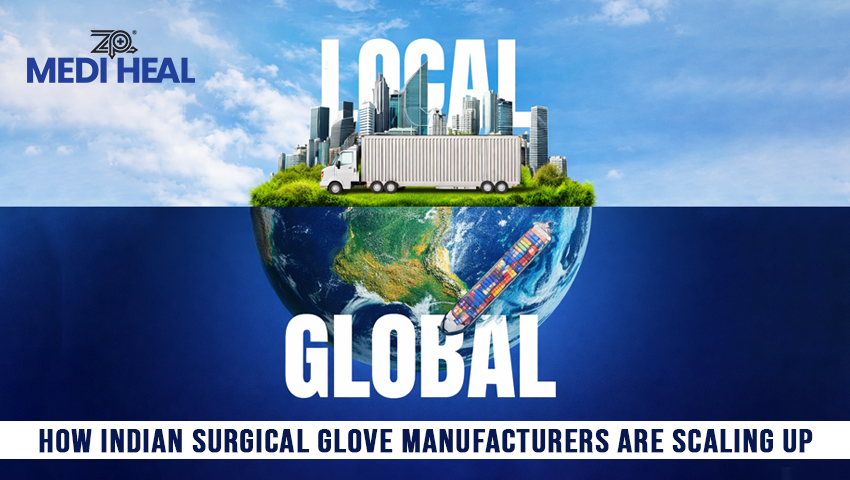
The medical supplies industry in India is experiencing a remarkable change, and one of the best illustrations of this change is the recent emergence of Indian manufactures of surgical gloves. Prior to the current decade, India relied on imports for high quality surgical gloves; however, today, India is developing a robust base of manufacturers with an increased ability to supply the demand for surgical gloves in the domestic market and has begun to establish a presence on the global market. At ZP MediHeal, we have seen this transformational change; it demonstrates a greater focus on self reliance and innovation along with adherence to global standards within the health care industry in India.
India’s increasing Health Ecosystem is creating a growing opportunity
The last decade has experienced an incredible increase in the growth of India’s Healthcare sector. The increased number of surgeries, the growth of hospital infrastructure, and the heightened concern regarding cleanliness and safety have all contributed to the demand for surgical and disposable gloves in India. Following the outbreak of COVID-19, this demand for gloves increased significantly due to the focus on infection control by hospitals, clinics, pharmacies, and diagnostic labs.
Due to the growing demand for high quality gloves, Indian companies that manufacture gloves have to increase their production capacity and incorporate more advanced materials. Today, India no longer views surgical gloves as a commodity to be imported cheaply; instead, they are seen as essential medical products that must meet global safety and performance standards. This shift in perception is a key reason why local manufacturers are investing more heavily in research, technology, and automated production.
From Dependence to Dominance: India’s Manufacturing Evolution
For years India depended significantly on imported gloves, from Southeast Asian nations recognized for their extensive production capabilities. This reliance posed two issues: varying quality and unstable costs. Indian producers, smaller enterprises struggled to match the scale and productivity of international suppliers.
Nevertheless, over the few years the situation has transformed significantly. Indian firms ranging from established manufacturers to MSME participants have enhanced their facilities and quality assurance mechanisms. Contemporary glove production now involves automated dipping systems, controlled clean room settings, pinhole detection tools and rigorous sterilization procedures. These enhancements have not elevated glove quality but have also positioned Indian brands as strong contenders, in international markets.
The result: Indian manufacturers are increasingly being recognized for their reliability, consistency, and improved product standards. Many are expanding production capacities significantly to meet rising domestic demand and export requirements.
Diversifying Materials: Latex, Nitrile, and Beyond
As the industry progressed numerous companies began incorporating a variety of materials yet the arrival of Nitrile gloves represents a straightforward advancement from latex gloves, which have been extensively employed across India until today. Latex gloves remain extremely pliable. Provide excellent tactile sensitivity making them ideal for surgical applications. The demand, for a material and the widespread incidence of latex allergies have driven producers to increase their adoption of nitrile gloves.
Similar to latex gloves nitrile gloves offer resistance to punctures along with chemical protection and hypoallergenic qualities. The rising demand for gloves has encouraged investment from Indian producers in setting up nitrile manufacturing plants enabling them to manufacture both nitrile and latex gloves. Consequently, this facilitates supply of gloves for medical and industrial purposes, from India.
As a result of this diversification of materials, the quality of products produced by Indian manufacturers will increase. As growth continues around the world, more and more manufacturers will need to rely on Indian suppliers to meet increasing demand for nitrile gloves throughout the supply chain globally.
Setting Global Standards: Quality as a Foundational Principle
Scaling up is not just about expanding production in terms of quantity, but also about improving production quality. If India wants to become a top supplier of surgical gloves in the global marketplace, then it must place the quality of surgical gloves as one of its highest priorities.
Manufacturers are increasingly embracing:
- Internationally recognized Quality Certifications
- Powder free and low protein glove technologies
- Improved Sterilization Methods
- Automated Inspection Equipment
- Improved Packaging and Shelf Life Protection
These improvements enable Indian manufactured gloves to conform to the most rigorous global regulatory requirements in Europe, Africa, The Middle East and South America. As a result, exporter of surgical gloves to Hospitals, Medical Distributors, Emergency Care Networks, and Industrial Workplaces throughout the globe.
Obstacles to Global Leadership for India
Despite strides, in asserting itself as a global leader India continues to face ongoing challenges.
1 Pricing Competition
Companies, in Southeast Asia are able to manufacture and market some products at lower costs compared to Indian manufacturers. For Indian manufacturers to effectively compete with these low cost companies they must distinguish themselves through value, innovation and quality.
2 Access to Raw Materials
Obtaining latex and raw materials will continue to pose difficulties for Indian producers since these items are procured via international supply networks. Variations in rubber and chemical costs will affect the production expenses of goods made from these substances along, with numerous other products.
3 Meeting Regulatory Requirements
When shipping products, to developed nations producers are required to comply with regulations established by global regulatory authorities. Consequently, producers must consistently allocate resources to product testing, record keeping and obtaining certifications to effectively export goods to developed markets.
4 Technology Gaps Between Older and Newer Manufacturing Facilities
Numerous older and smaller manufacturing plants in India still lack automation and/or clean room facilities posing a difficulty, for these firms to compete on a global scale.
Despite these obstacles, the Indian manufacturing industry is progressing forward with continued modernization and improvement, thereby closing many of these gaps.
Reasons why Indian Manufacturers have the potential to grow globally
Increasing global demand for gloves; primarily due to the use in the healthcare, food safety, and industrial sectors.
- Support from the Indian Government that has increased support for domestic production of medical products.
- Highly Automated, high capacity production lines will provide the ability to produce on a larger scale.
- Continued focus and use of renewable, biodegradable, ecologically safe materials; i.e., reducing the impact on the environment.
- Increased awareness surrounding, hygiene, cleanliness, disease prevention, etc., across many different industries, households.
When these elements are combined, and Indian manufacturers have access to highly skilled labor, and they are continuing to develop their own infrastructure; India’s manufacturing base will have a strong advantage against existing manufacturers and global competitors.
ZP MediHeal’s Perspective on India’s Global Ascent
At ZP MediHeal we consider this shift a milestone for the nation’s medical manufacturing sector. Transitioning from a supplier to an international competitor involves more than just increasing output; it involves fostering trust guaranteeing safety and reinforcing India’s role, in worldwide healthcare supply networks.
We take pride in backing and working alongside manufacturers who emphasize innovation, ethics and high standards. As the sector progresses we anticipate that India will emerge as one of the dependable centres, for producing surgical and medical gloves globally.
Conclusion: A New Chapter for India’s Medical Manufacturing Industry
Indias rise in the surgical glove sector mirrors a nationwide movement toward self sufficiency and international competitiveness. Through adopting technology improved quality benchmarks and increased manufacturing capabilities Indian producers are not simply fulfilling local demands; they are gaining acclaim, in global markets.
The path forward is rich with possibilities. Through investment, creativity and dedication to quality India is steadily advancing toward becoming a leading global force, in the production of surgical gloves.
ZP MediHeal is proud to be part of this exciting chapter and remains dedicated to supporting India’s growth in the global med tech landscape.
Recent Posts