24 Aug, 2026
A mattress is one of the most overlooked breeding grounds for bacteria, fungi, and unpleasant odours in any home, hospital, or care facility. It sits underneath a person for hours at a stretch, quietly absorbing sweat, spills, and in the case of patients dealing with incontinence, post surgical recovery, or long term bed rest far more than that. Once moisture works its way into a mattress, it rarely leaves on its own. What follows is often mould growth, bacterial buildup, persistent odour, and in clinical settings, a real risk of infection for an already vulnerable patient.
This is exactly the problem waterproof underpads are designed to solve. They are simple, inexpensive, and remarkably effective at keeping a mattress dry, clean, and hygienic which, in turn, protects the person lying on it. In this article, we’ll break down how moisture actually damages a mattress, why that matters for infection control, and how a good underpad interrupts the whole process before it starts.
Why a Damp Mattress Is a Health Risk, Not Just a Hygiene Issue
It’s easy to think of a stained or damp mattress as simply unpleasant rather than dangerous. In reality, the two are closely linked.
Mattress interiors foam, cotton padding, coil systems are excellent at trapping moisture and terrible at releasing it quickly. When urine, sweat, wound drainage, or other bodily fluids seep past the top layer of fabric, they settle deep into the padding where air can’t reach them. That damp, warm, enclosed environment is close to ideal for microbial growth. Bacteria multiply rapidly in these conditions, and mold spores that would otherwise stay dormant find exactly the moisture they need to spread.
For a healthy person, this mostly means a smelly, degraded mattress. For a patient recovering from surgery, managing a chronic illness, dealing with incontinence, or simply immobile for long stretches, it means something more serious: repeated skin contact with a contaminated surface, a higher chance of bedsores becoming infected, and a general drop in the standard of hygiene around their recovery. In hospitals and nursing homes, a soiled mattress that can’t be properly sanitized between patients is a genuine infection control failure, not a cosmetic one.
What Actually Happens Without an Underpad
Without a barrier layer, every spill, leak, or accident goes directly into the mattress. A few things tend to follow:
- Fluid soaks past the surface fabric and reaches the internal padding within minutes, especially with foam mattresses.
- The mattress cannot be effectively disinfected once fluid has penetrated below the surface wiping the top does nothing for what’s soaked in underneath.
- Odour builds up over repeated exposures, as organic material breaks down inside the padding.
- The mattress itself deteriorates faster, with foam breaking down and fabric weakening, shortening its usable life considerably.
- Cross contamination risk rises in shared or multi patient settings, where the same mattress may be used again before it’s truly clean.
None of this is reversible by cleaning the surface. Once moisture is inside, the damage and the health risk is already done.
How Waterproof Underpads Break the Cycle
A waterproof underpad works on a simple principle: stop the fluid before it reaches the mattress at all.
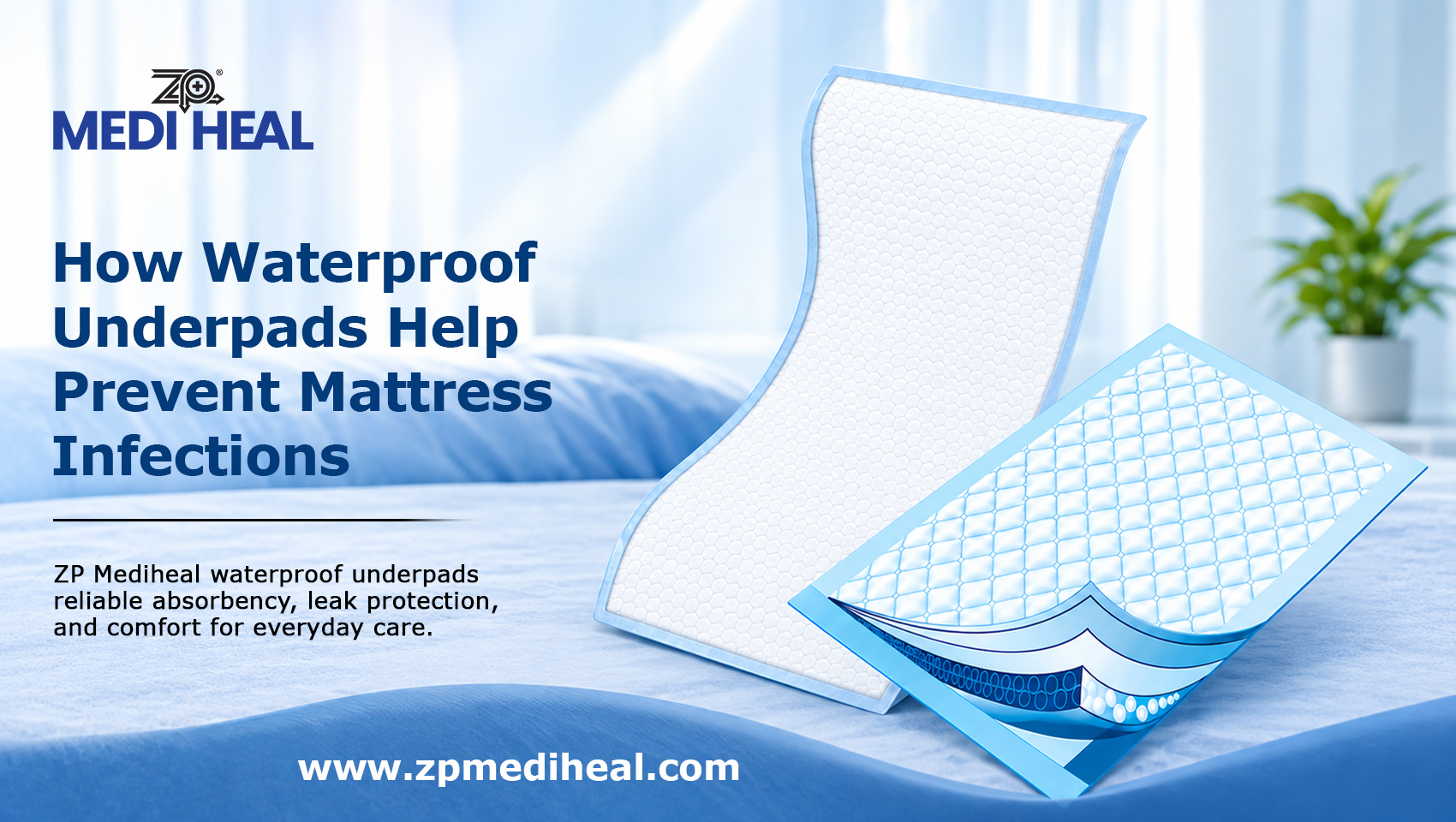
A good quality underpad, like the ones ZP Mediheal manufactures, typically has three functional layers. The top layer is a soft, absorbent fabric that draws fluid away from the skin quickly, so the person lying on it stays dry and comfortable rather than sitting in dampness. The middle layer is a highly absorbent core that locks that fluid in, preventing it from spreading sideways across the pad or pooling in one spot. The bottom layer is a waterproof barrier, usually a PU or PE coating, that stops any fluid from ever reaching the mattress underneath, no matter how saturated the pad becomes.
The result is that the mattress underneath stays completely dry, even after repeated use. Because nothing seeps into the padding, there’s no damp environment for bacteria or mold to grow in. And because the underpad itself sits on top and can be changed, washed, or disposed of, cleaning between uses becomes fast and thorough rather than a losing battle against a mattress that’s already contaminated.
Where This Matters Most
Hospitals and clinics. Between patients, a mattress needs to be as close to sterile as possible. Underpads make this realistic by keeping fluids off the mattress surface entirely, which shortens turnover time and reduces the odds of one patient’s infection risk being passed on to the next.
Nursing homes and elderly care. Incontinence is common among elderly residents, and daily accidents are simply part of the reality of care. A reliable underpad means staff can manage this without the mattress slowly degrading underneath every resident it’s used with.
Post surgical and home recovery. Wound drainage, sweat from fever, and general immobility all put steady moisture pressure on a mattress during recovery. An underpad protects both the mattress and the healing skin of the patient, since dry bedding is also gentler on sensitive or healing skin.
Paediatric and bedwetting use. For children who wet the bed, underpads mean parents don’t need to replace mattresses or run mattress protectors through the wash constantly; the pad absorbs the accident and can simply be swapped out.
Reusable vs. Disposable: Choosing What Fits
Waterproof underpads generally come in two types, and the right one depends on the setting.
Disposable underpads are used once and thrown away. They’re the standard choice in hospitals and clinical environments where hygiene protocols require a fresh, uncontaminated pad every time, and where laundering isn’t practical between uses.
Reusable underpads are made from washable, durable fabric and can be laundered and used again, often hundreds of times. These are a strong fit for home care and long term use, since they reduce ongoing cost and waste while still offering the same waterproof protection.
Both types serve the same core purpose of keeping fluid away from the mattress so the decision usually comes down to frequency of use, budget, and whether single use hygiene standards are required.
A Small Product With a Real Impact on Health Outcomes
It’s tempting to think of a mattress underpad as a minor convenience item, but in both clinical and home settings, it’s doing real preventive work. By keeping the mattress dry, it removes the conditions bacteria and mould need to establish themselves. By making cleanup fast and complete, it supports proper hygiene practices instead of working against them. And by protecting the mattress itself, it extends the life of equipment that’s often expensive to replace.
At ZP Mediheal, our waterproof underpads are built specifically with this in mind: reliable absorbency, a dependable waterproof base, and comfort for the person using them. Whether it’s for a hospital ward, a care facility, or a loved one recovering at home, a good underpad is one of the simplest ways to keep a bed genuinely clean, not just clean looking.
To explore ZP Mediheal’s range of waterproof underpads and other patient care essentials, visit www.zpmediheal.com.
Recent Posts